Detailed Project Management:
Work Breaddown Structure:
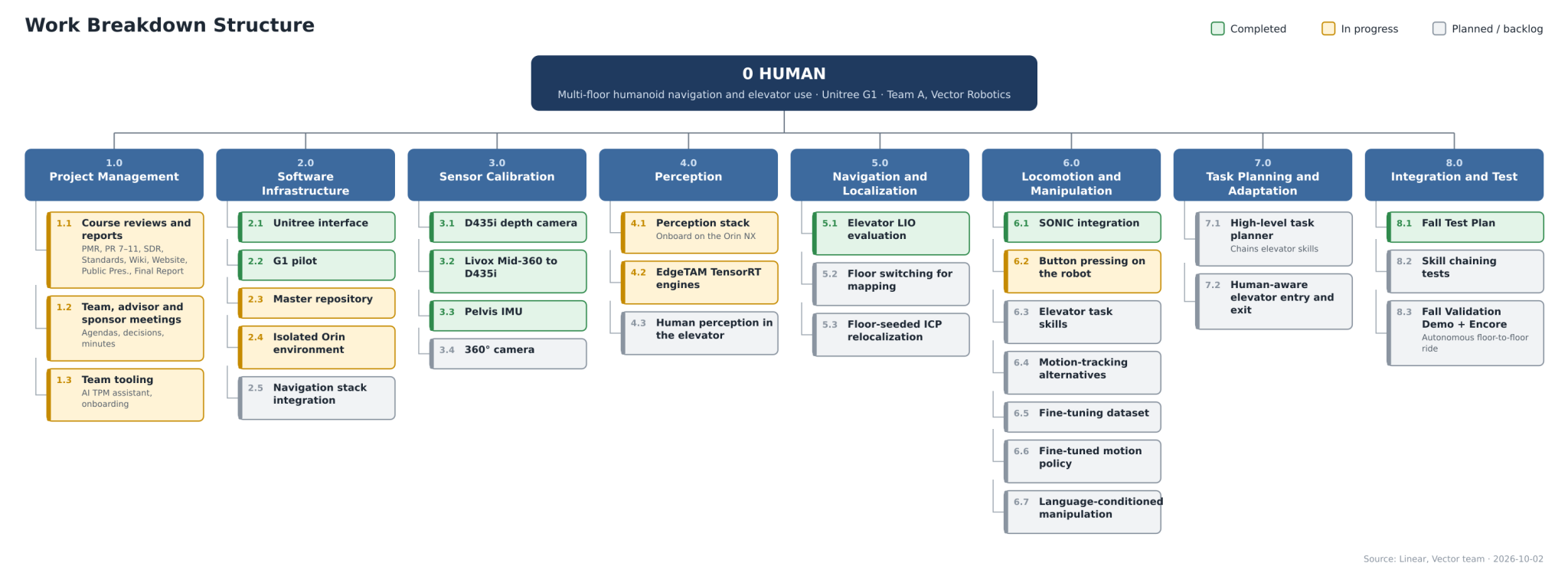
Spring Performance Results:
- Button Detection:
- Requirement: SR > 33%.
- Achieved: 90% (18/20) for both in and out the elevator.
- Press Elevator Button:
- Requirement: SR > 33%.
- Achieved: 85% (17/20) for raised button. 50% (5/10) for inset button.
- Visual Servo Base:
- Requirement: SR > 33%.
- Achieved: Detection: 82% (36/44), Servoing: >95% (19/20), Combined 78%
- Door State Detection:
- Requirement: SR > 33%.
- Achieved: ~100% (3/3), generalized to different elevators
- Enter Elevator:
- Requirement: SR > 33%.
- Achieved: ~100% (20/20)
- Elevator Floor Detection:
- Requirement: SR > 33%.
- Achieved: ~80% (4 out of 5 elevators, 100% on the 4 elevators)
- Exit Elevator:
- Requirement: SR > 33%.
- Achieved: ~100% (6/6)
Part List:
Design Brain-Storming:
- Each module outputs a confidence score, and the behavior tree decides whether to execute, retry, change viewpoint, or switch to a fallback route.
- Store doors, elevators, stairs, and buttons as semantic landmarks with preferred approach poses, viewpoints, and interaction poses.
- Use high-level symbolic planning for route/task sequencing, but use local reactive controllers for fragile interactions like door opening and button pressing.
- Start with VLM-based object localization, then switch to lightweight tracking or geometric priors during execution to reduce latency and improve robustness.
- Design every major skill with explicit failure modes, timeout logic, retry limits, and user-facing explanations.
- First validate isolated artifact skills, then short skill chains, and only finally the full multi-floor mission.