Schedules
Spring Progress Reviews
| Date | Progress Review No. | Presenter |
|---|---|---|
| Feb 5, 2026 | Sensors & Motors Lab | Tina Hsu |
| Feb 12, 2026 | PR #1 | Jerry Hou |
| Feb 26, 2026 | PR #2 | Prakhar Mishra |
| Mar 19, 2026 | PR #3 | Robert Kerwin |
| Apr 2, 2026 | PR #4 | Joy Yang |
| Apr 16, 2026 | Spring Validation Demonstration (PR #5) | All |
| Apr 23, 2026 | Spring Validation Demonstration Encore (PR #6) | All |
Fall Progress Reviews
| Date | Progress Review No. | Presenter |
|---|---|---|
| Sep 9, 2026 | PR #7 | Prakhar Mishra |
| Sep 23, 2026 | PR #8 | Robert Kerwin |
| Oct 7, 2026 | PR #9 | Joy Yang |
| Oct 28, 2026 | PR #10 | Tina Hsu |
| Nov 11, 2026 | PR #11 | Jerry Hou |
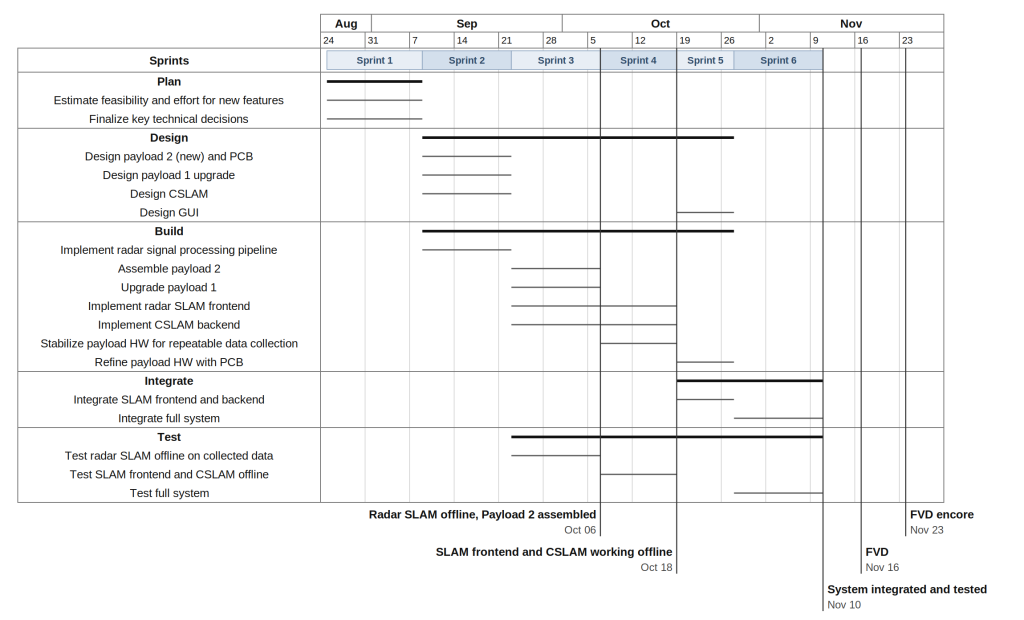
| Nov 16, 2026 | Fall Validation Demonstration (PR #12) | All |
| Nov 23, 2026 | Fall Validation Demonstration Encore (PR #13) | All |
| Dec 2, 2026 | Public Poster Presentation | All |
Spring Test Plans
System Validation Demo Guidelines
SVD Goal:
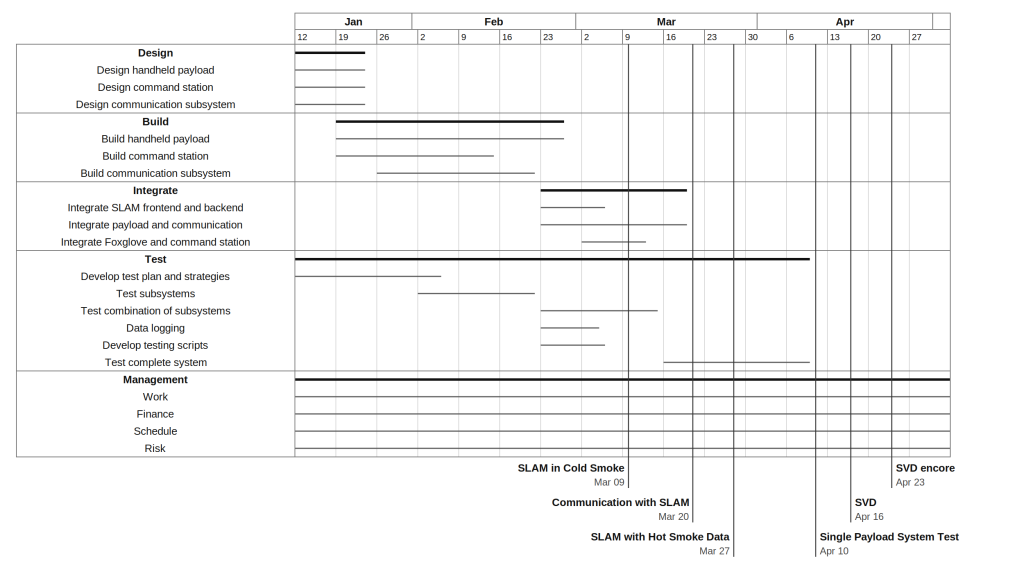
For our Spring Validation Demo, we plan to showcase SLAM operating in cold smoke conditions using a single payload with a robust communications setup. The demo will highlight multi‑story mapping capability and the system’s ability to handle rapid firefighter motion, along with preliminary results on SLAM performance on a hot-smoke dataset.
Location: Allegheny County Fire Academy (ACFA)
Verification Criteria:
- Set up FireSense Payload v1.1 – verify sensor feeds and payload battery level.
- Setup command station.
- Verify the communication link between the payload and the command station exists.
- Verify the Record Button is working to record ROS topics.
- Fill in the metal building at ACFA with a smoke machine. Place miscellaneous home furniture at various places in the building.
- Present the system to the audience.
- One team personnel wear masks and enters the smoke-filled area carrying the payload. Another explains a live GUI to the audience.
- The person first moves from one room to another in the building.
- If the SLAM performance is satisfactory in slow motion, proceed to move the payload at a fast speed. Move to a different floor and observe multi-floor SLAM performance.
- End operation after 15 minutes at the marked starting point.
- Use a recorded ROS bag to benchmark SLAM performance against ground truth.
Procedure:
- Loop closure detection works correctly.
- No gaps in trajectory or map.
- Continuous data link between payload and command station.
- Absolute translation error ≤ 1 m, using the starting point as reference.
- Absolute orientation error ≤ 45◦, using starting point as reference.