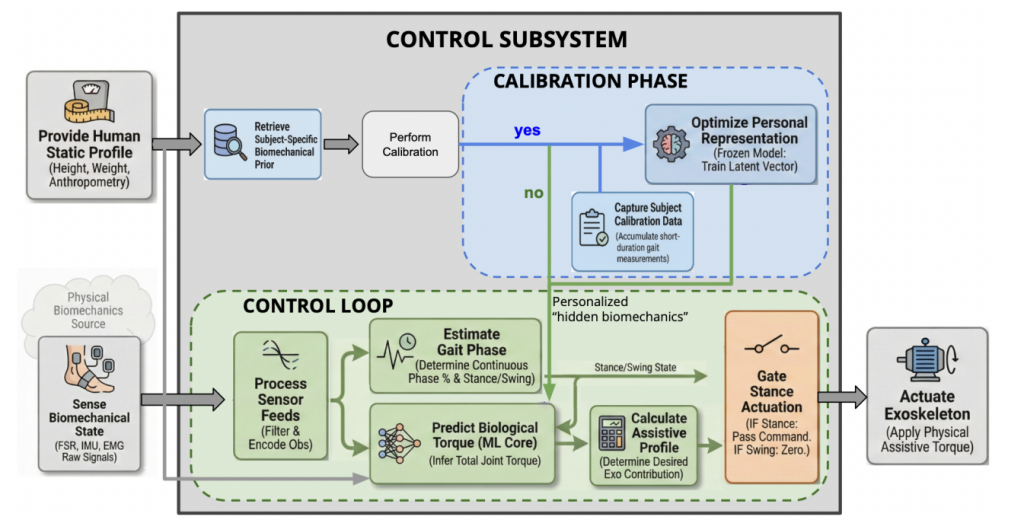
Functional Architecture

The functional architecture of the exoskeleton system is organized around four major subsystems: the Mechanical Brace, the Sensing Subsystem, the Control Sub-system, and the Actuation Subsystem. The system’s primary goal is to provide assistive torque during walking, which is achieved through a cyclical process. Besides the subsystems, the architecture also shows an important part of the system, the required external resources and the desired output. The Human Static Profile provides essential, static biomechanical priors directly to the Control Subsystem during a Calibration Phase to optimize the personal representation. The Sensing Subsystem continuously monitors key dynamic biomechanical parameters from the user and Mechanical Brace. After processing and safety checks, these feeds enter the Control Loop of the Control Subsystem, which then drives the Actuation Subsystem to apply the necessary assistive forces, closing the control loop.
Cyberphysical Architecture


Based on the subsystem level trade studies conducted the above diagram describes the optimal cyber-physical architecture. It highlights which component(s) is/are responsible for their corresponding subsystem. The above mentioned components are responsible for the following:
- Mechanical Brace: Responsible for holding the lower leg firmly in place while propagating actuation and providing feedback.
- Teensy 4.1: Microcontroller responsible for processing all sensor inputs (IMUs, FSRs, and Motor Encoders) to look out for emergency stop cases, safety thresholding of motor, and passing necessary data to the Control subsystem.
- NVIDIA Jetson Nano: Responsible for all the RL/ML control algorithms for calibration and the control loop.
- AK 80-9 Robotic Actuator: Responsible for bowden cable actuation through low level control using the Teensy 4.1 and inbuilt FOC capable motor-driver.
Control Architecture