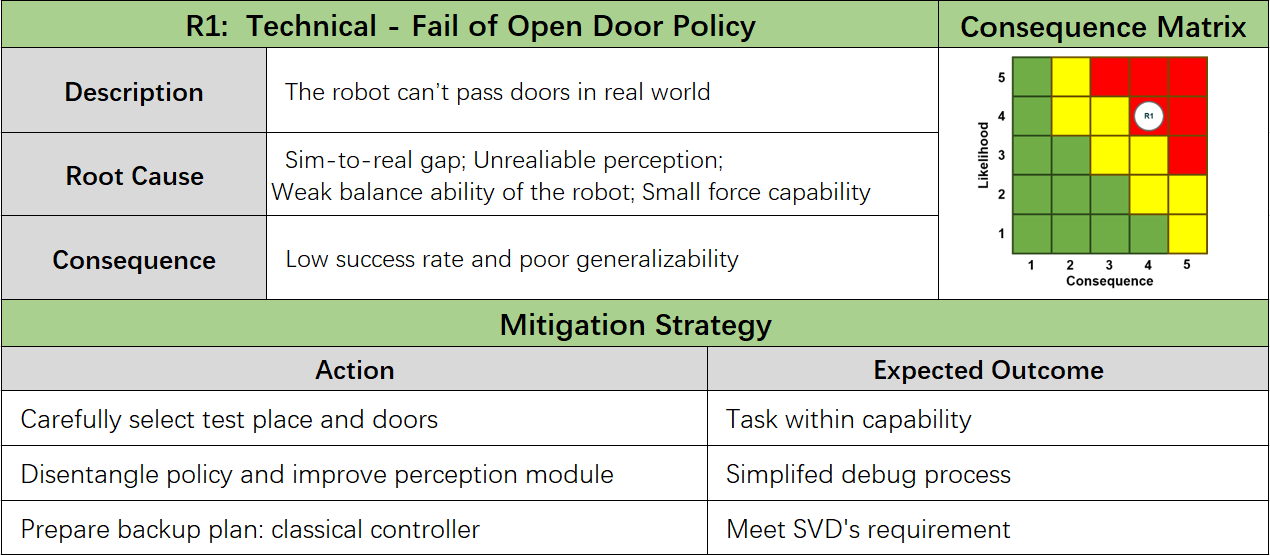
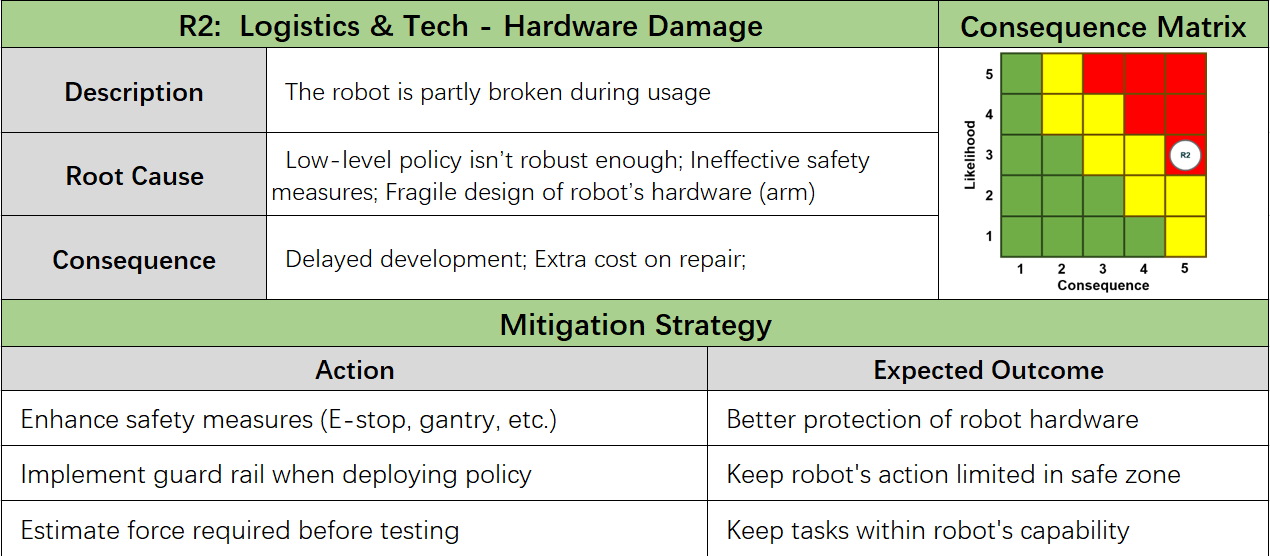
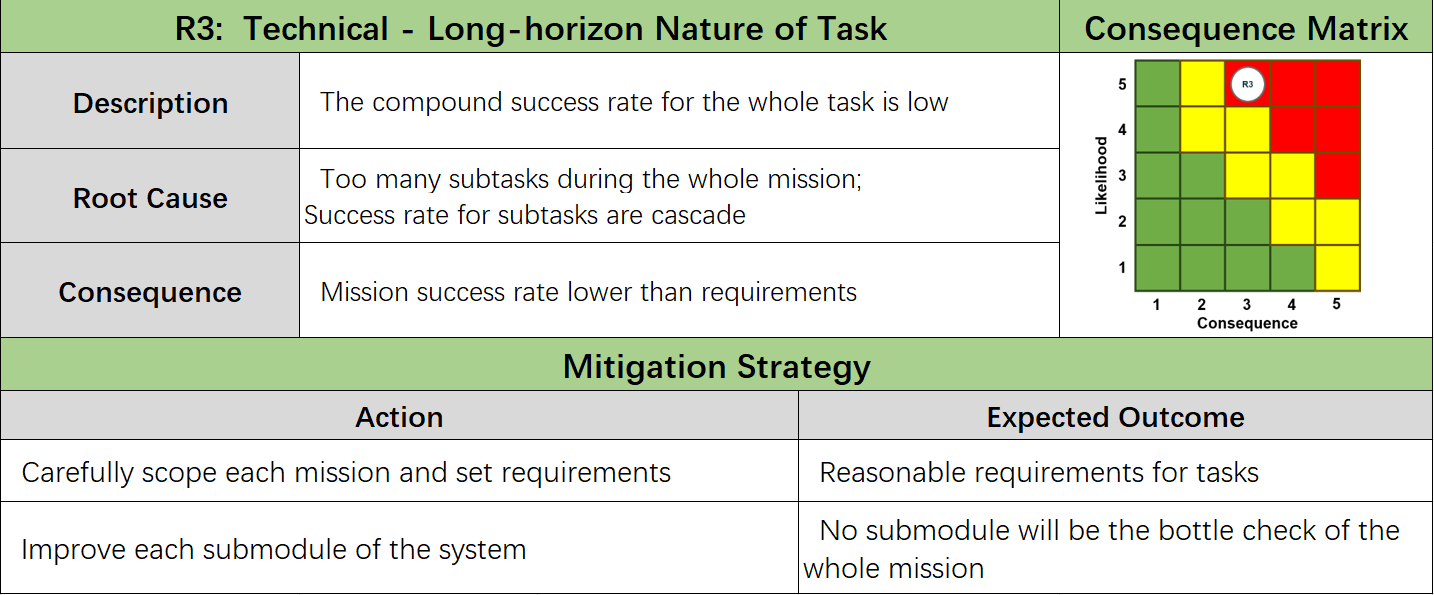
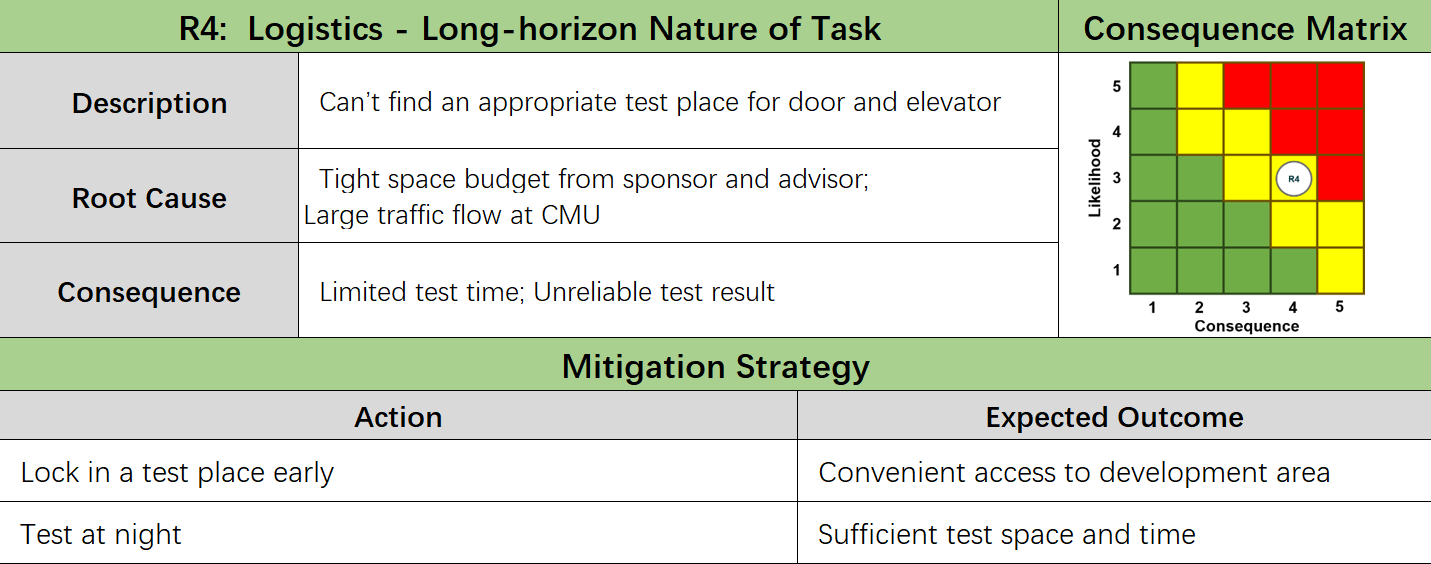
we have identified and continuously monitored key risks that could affect the progress of our project. These risks span both technical and logistics domains. The risk matrices outline each identified risk along with its likelihood, severity, and planned mitigation approach. In general, our mitigation are mainly designed to reduce the likelihood of all the risks identified. The majority of the risk will be under control as the project proceeds as planned. The risks are listed below.
Risks identified in the Fall:
The Fall 2026 risks below summarize the team’s risk register and subsequent project updates through September 25, 2026. They cover technical reliability, integration, resources, and delivery. Current status distinguishes ongoing risks from mitigations already reported.
Likelihood and consequence ratings are omitted pending review. Expected outcomes are mitigation objectives, not verified results.
Technical — Button Pressing and Skill Chaining
Risk register: R-05, R-19
Description
Unreliable button presses or brittle transitions between skills can prevent a complete elevator mission.
Root Cause
Button-localization errors, stale robot poses, planning latency, and variation in the robot’s final walking pose.
Consequence
Individual skills may work in isolation while the complete mission fails.
Current Status
Active. September 22 tests still showed button-dependent reliability: 1 of 7 lower-button presses and 6 of 7 upper-button presses succeeded. End-to-end reliability remains to be demonstrated.
Mitigation Strategy
Action
Expected Outcome
Improve calibration, track time-tagged trajectories, run manipulation on the NUC, and refresh the base pose within one second of arm motion.
More repeatable button contact and less error from delayed state estimates.
Retain fixed-floor chaining and a demonstration-site detector fallback; demonstrate difficult skills separately if necessary.
Preserve a demonstrable baseline while integrated reliability improves.
Technical — Perception and Localization Accuracy
Risk register: R-09, R-13, R-21
Description
Unstable detections, orientation error after walking, or camera-to-robot transform error can displace the estimated button target.
Root Cause
Detection variability, imperfect extrinsic calibration, and differences between the planned and actual robot pose.
Consequence
The robot may approach the wrong contact point or lose a usable view of the panel.
Current Status
Active. Calibration has been revised, but repeatable button-position errors in later hardware tests still require investigation.
Mitigation Strategy
Action
Expected Outcome
Use object tracking and multi-frame agreement before solving the arm motion; use visual feedback to correct alignment.
A more stable target estimate and better alignment before contact.
Refine and validate camera-to-robot calibration; retain manually tuned or CAD-derived extrinsics as a fallback.
Reduce systematic target offsets across the perception and manipulation pipeline.
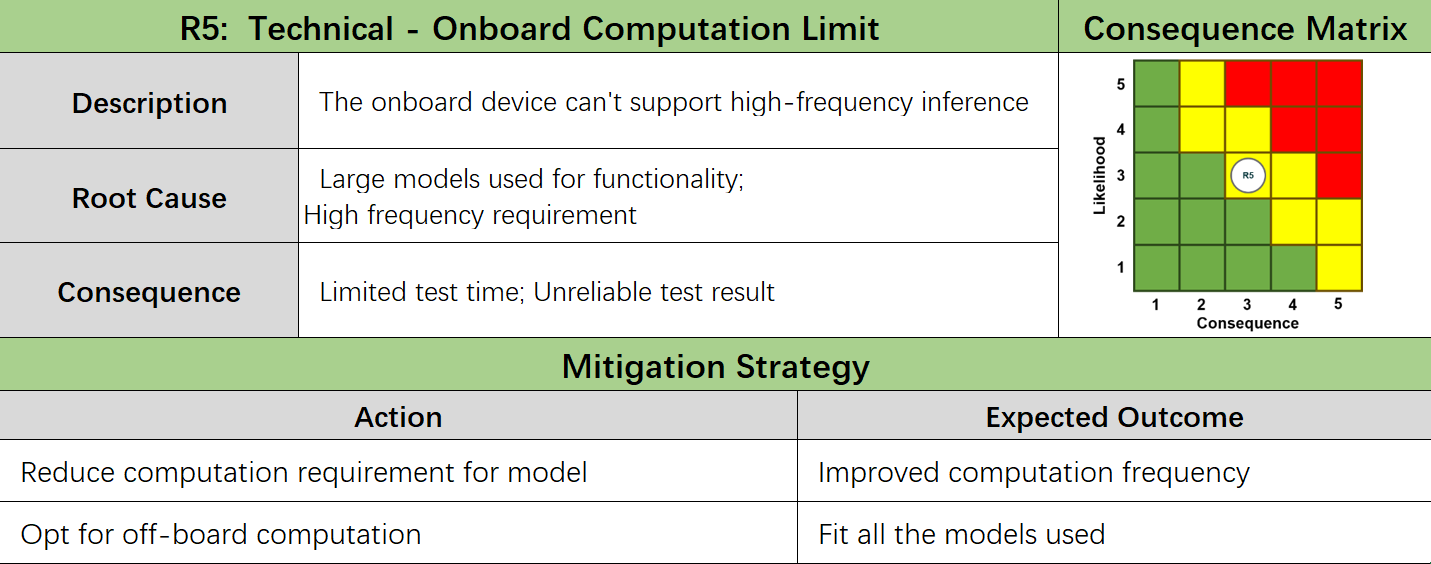
Technical — Communication and Compute Performance
Risk register: R-04, R-10
Description
Loss of connectivity or excessive processing latency can interrupt perception and control during the elevator mission.
Root Cause
Dependence on external compute and processing stages that cannot meet the required update rate.
Consequence
Perception may stop during the ride, or control may use readings that are too old.
Current Status
Partly mitigated. Local deployment and VLM benchmarking have progressed. Tracking speed was reported as no longer a blocker on September 25; integrated performance still needs validation.
Mitigation Strategy
Action
Expected Outcome
Run inference locally and allocate perception and manipulation workloads to suitable processors.
Reduce dependence on external Wi-Fi and lower processing delays.
Keep the IMU-based floor-detection pipeline available as a fallback.
Maintain floor estimation when vision or its communication path is unavailable.
Schedule — Development and Module Integration
Risk register: R-01, R-02
Description
New capabilities or separately developed modules may not converge and integrate before the final demonstration.
Root Cause
Uncertain development effort and dependencies between module interfaces, testing, and integration.
Consequence
The team may have working components without a complete, demonstrable mission.
Current Status
Active. The baseline mission and the integration of additional capabilities must be evaluated separately.
Mitigation Strategy
Action
Expected Outcome
Define module interfaces and use recorded data and simulation as shared validation references.
Expose integration mismatches before full hardware testing.
Use a development checkpoint and reserve the final month for the baseline; fall back to fixed-floor chaining or a separate module demonstration where needed.
Protect time for a demonstrable elevator mission if additional capabilities are not ready.
Personnel and Schedule — Team Availability
Risk register: R-07
Description
Coursework and project deadlines compete for the team’s available engineering time.
Root Cause
Two concurrent courses and fluctuating availability across team members.
Consequence
Testing, integration, and documentation may slip during overlapping deadlines.
Current Status
Open. As of the September 25 update, the register still had no assigned risk owner or agreed mitigation.
Mitigation Strategy
Action
Expected Outcome
Scheduling agreement and risk ownership: to be confirmed by the team.
A documented allocation of time and responsibility across overlapping deadlines; not yet established.
Logistics — Hardware Availability and Test Conditions
Risk register: R-03, R-06, R-16
Description
Unavailable equipment, component failure, or restricted test access can reduce hardware-validation time.
Root Cause
Shared robot use, motor or sensor faults, and constraints around the test environment and public access.
Consequence
Fewer representative trials and delays in diagnosing or reproducing failures.
Current Status
Under review. Moving to the RIC service elevator reduced booking and permitted-hours constraints. Hardware availability and the earlier breakdown-risk assessment still need review.
Mitigation Strategy
Action
Expected Outcome
Maintain spare parts and vendor support, and use redundant sensors where practical.
Shorter interruptions when a component becomes unavailable.
Use the RIC test venue and complement robot trials with recorded-data and simulation tests.
More predictable access and continued validation when hardware testing is limited.
Programmatic — Deliverable and Stakeholder Alignment
Risk register: R-08
Description
The delivered capabilities or demonstration may not match advisor and sponsor expectations.
Root Cause
Changes in project scope and different expectations for technical progress and the final deliverable.
Consequence
A technically useful result may not satisfy the intended evaluation or sponsor outcome.
Current Status
Active. Keep the final deliverable aligned with the engineering baseline and the agreed demonstration scope.
Mitigation Strategy
Action
Expected Outcome
Build on the Spring stack, retain the engineering core, and show progress at two-week intervals.
Earlier feedback on scope and clearer evidence of progress.
Maintain a strong demonstration video as a documented fallback deliverable.
A clear, reviewable record of achieved system capabilities.